
Why Sustainable Change Requires a Bigger Picture
In conversation with Rodrigo Fanjul, Supply Chain & Logistics Sustainability Expert
by Raffaella Loncao
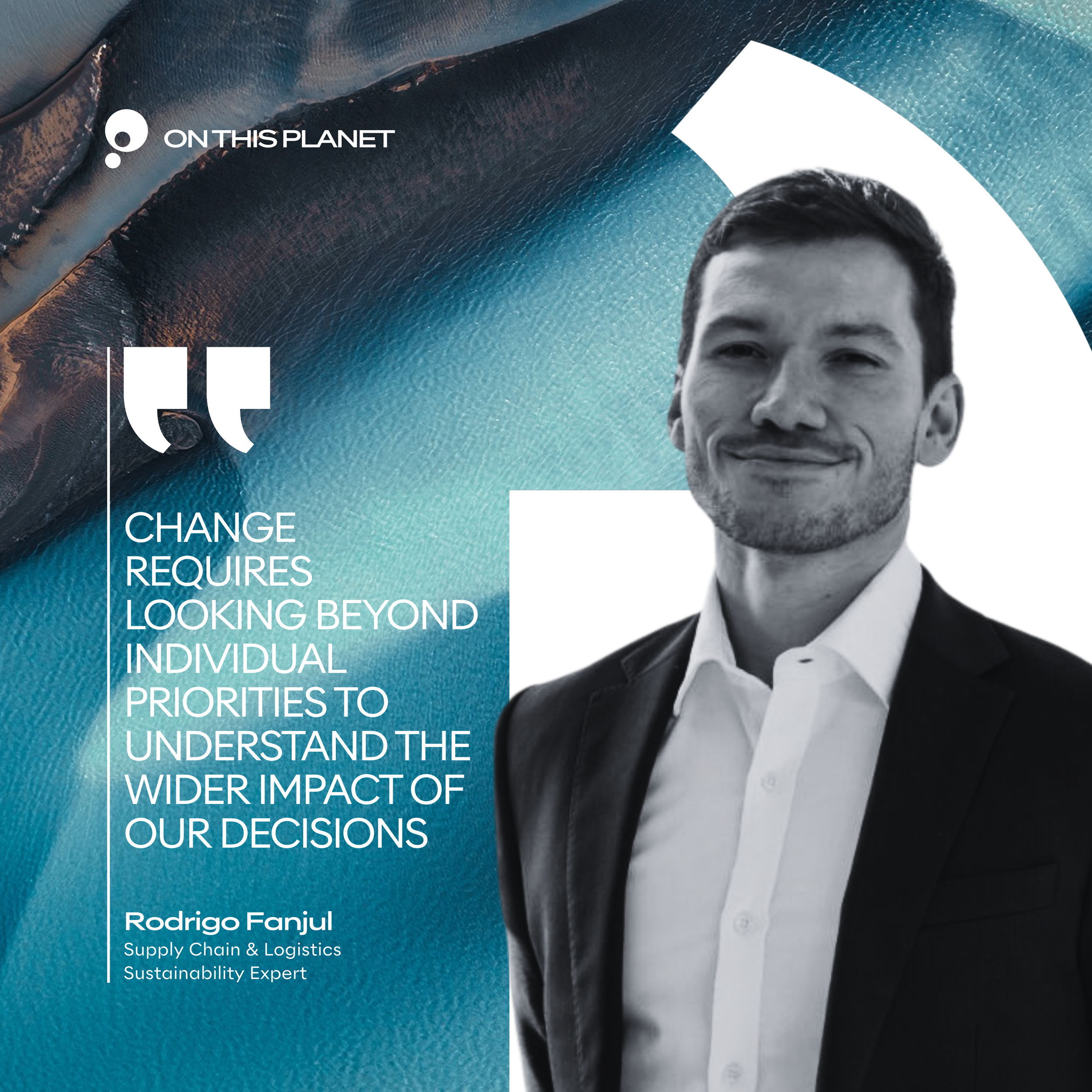
Rodrigo Fanjul has spent much of his career working in international trade and supply chains, from agricultural commodities in Argentina to luxury fashion in Europe and Australia. Throughout this journey, his love for the natural world has remained a constant, gradually shaping his belief that businesses need to look more carefully at the environmental consequences of their everyday decisions.
Working in supply chain and logistics, Rodrigo began questioning practices that seemed perfectly reasonable from a commercial perspective but carried significant environmental consequences. He remembers seeing products that had taken months to manufacture being transported by air to reach stores as quickly as possible, sometimes small items packed in disproportionately large boxes. These experiences led him to question how businesses balance commercial priorities with their environmental commitments.
“Sustainability objectives are often fragmented, even within the supply chain itself.”
Companies may have ambitious environmental targets, yet the people responsible for purchasing, inventory, logistics and retail are not necessarily working towards the same priorities, making it difficult to understand the collective impact of their decisions.
Aligning Business Objectives with Sustainability
Rodrigo describes how different functions can make decisions that are individually justified but collectively undermine a company's environmental ambitions. Consider the choice between shipping products by air or by sea. For a logistics team measured on how quickly merchandise reaches stores, air freight may be the obvious solution, while for a sustainability team responsible for reducing emissions, the same decision works against its environmental objectives.
The contradiction becomes particularly evident when financial incentives reward one outcome while sustainability targets encourage another. Rodrigo believes environmental performance should be reflected in the objectives and incentives of employees throughout the business, rather than remaining primarily the responsibility of sustainability teams or senior management.
Inventory management offers another example. Product teams want to provide customers with a complete assortment, yet products that remain unsold are often shipped back to warehouses, sometimes after travelling considerable distances. These are beautifully made products that have required substantial resources, craftsmanship and energy to produce, only to become another logistical challenge when they fail to sell.
Rodrigo reached a point when he stopped looking at inventory simply as a number of units and began seeing it in terms of its environmental footprint. This invites us to reconsider how we measure the value of a product, recognising that decisions about how much to produce, where to distribute it, how frequently to move it and what happens when it remains unsold all contribute to the environmental impact of the business.
He raises similar questions about packaging, store planning materials and employee uniforms. A change in creative direction might lead a company to replace uniforms across its retail network, but is also important to consider the availability of appropriate recycling facilities in the countries where the previous uniforms are sent for disposal. For Rodrigo, these examples illustrate why improving sustainability requires a more holistic understanding of how different business activities are connected.
Connecting the Dots
As we explore possible solutions, Rodrigo returns to the importance of understanding the bigger picture. He believes leaders need to become more comfortable working with environmental data and assessing the relationship between commercial performance and environmental impact, ensuring that this information influences decisions across the organisation rather than simply serving as a measure of progress.
He suggests that companies should increasingly evaluate profitability alongside the carbon footprint of their activities, making the environmental consequences of commercial choices visible before decisions are taken. Better inventory planning, more thoughtful product allocation, greater standardisation of packaging and materials, and a more selective use of air freight are among the opportunities he identifies.
What emerges from our conversation is that meaningful progress depends on the ability to bring different functions together, challenge established practices and recognise when decisions that make sense for one part of the business may create environmental costs elsewhere. This requires a shared understanding of success, supported by objectives that encourage people to consider the consequences of their decisions beyond their immediate responsibilities.
Remembering What We Are Trying to Protect
Towards the end of our conversation, Rodrigo returns to the natural world. He tells me that spending time outdoors helps him regain perspective, and that walking in nature, observing wildlife and remaining curious about the world around him remind him why environmental responsibility matters in the first place.
Rodrigo’s appreciation of nature has shaped his understanding of the global supply chains he has spent his career managing. His experience reminds us that meaningful progress depends on our ability to look beyond individual decisions, understand their wider consequences and rethink how we measure success.