
Why Hope Is a Leadership Strategy
In conversation with Nicky O’Malley, Chief Executive Officer at 30×30 UK
by Raffaella Loncao
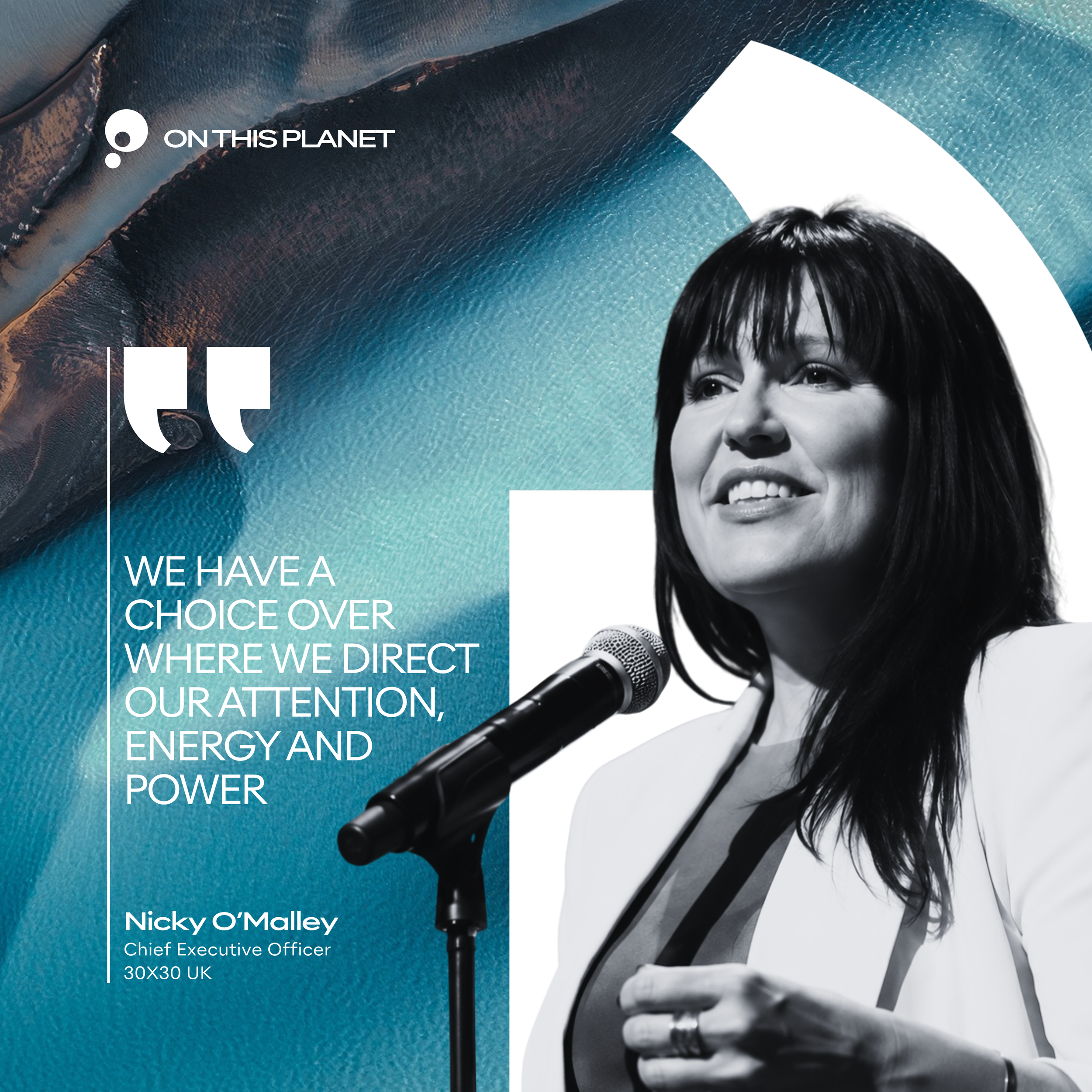
Nicky O’Malley’s warmth and positivity are infectious, even through a screen. There is an openness about her that makes conversation feel natural almost immediately.
Earlier in her career, she was advised to tone some of that down.
As a young professional, Nicky was told to smile less and be more serious if she wanted to have “greater gravitas” as a leader. She remembers the advice clearly, although the lesson she eventually took from it was almost the opposite. Today, she encourages people to be themselves rather than adopt someone else’s idea of what leadership and authority should look like.
That confidence in who she is has been shaped by experiences far beyond the workplace. Surviving the 2005 London bombings gave Nicky a second lifeline. She left a successful career in advertising and, as she recovered physically and mentally, her priorities changed. She decided to dedicate more of her time and energy to what had helped her heal: nature.
Success came to mean “using what I have to do the best I can.” Twenty-one years later, that intention is still visible in the choices she makes.
Planting Seeds of Hope
Nature has always played an important role in Nicky’s life. She describes it as her solace and her medicine, and its role in the healing she has experienced across her life has shaped a conviction that care for ourselves and care for nature are, in fact, one and the same.
Today, as CEO of 30x30 UK, her work focuses on turning commitments to protect and restore nature into practical action. The international 30x30 target calls for at least 30% of the world's land, inland waters, coastal areas and oceans to be effectively conserved and managed by 2030. The ambition has been agreed; Nicky is interested in how a target agreed at international level becomes something governments, businesses, investors, landowners and communities can actually deliver.
Her definition of success is grounded in that delivery. Theory of change, strategies and commitments all have their place, but eventually something has to change in the real world.
“I am planting seeds of hope.”
Hope comes up repeatedly in our conversation, although Nicky does not use the word to look away from difficult realities. She talks instead about directing time, energy and resources towards evidence that another future is possible. Her work sits somewhere between that possibility and the practical work required to deliver it.
Giving Nature a Voice in the Room
One of the structural barriers Nicky sees is the distance that can exist between sustainability teams and the parts of a business where major strategic and financial decisions are made. These teams carry considerable responsibility, but may have limited access to the conversations that determine priorities. In many cases, “if a sustainability leader is lucky, they get ten minutes in a board meeting once a month,” she says.
Biodiversity and nature can be even harder to bring into the room. Businesses have become increasingly familiar with carbon, emissions and climate targets, while nature is more complex. Companies depend on functioning ecosystems in ways that can be difficult to capture in a spreadsheet, and many of the services nature provides are still poorly reflected in conventional financial decision-making.
Nicky frames the challenge simply: “How do we give nature a voice in strategic decisions?”
For companies, that means moving the conversation beyond the sustainability department and into decisions about investment, risk, supply chains and long-term value. As she puts it, “What we are trying to do goes beyond a spreadsheet. We are trying to secure a better future for our planet.”
Making Space to See Clearly
For someone working with challenges of this scale, Nicky is deliberate about creating distance from the constant flow of information she encounters professionally. She regularly disconnects and spends time outside in nature, allowing ideas and experiences to settle before deciding where to direct her attention. She describes the process as recalibrating herself.
That distance gives her greater clarity about where to spend her time, energy and resources. Without it, she says, it is easy to live at the mercy of a busy schedule, continually responding to what is immediately in front of you without creating enough space to see the bigger picture.
Meditation plays a similar role. Our conversation moves naturally towards our shared interest in the practice and the place it can have in leadership. Nicky describes many of her decisions as coming from her heart and intuition, with meditation helping her move beneath the immediate noise and make choices from a more grounded place.
This becomes particularly relevant when we talk about information overload, one of the biggest leadership challenges she sees today. Leaders are expected to absorb an enormous amount of information while interpreting what matters and setting a direction for others to follow. Nicky’s response is to create enough distance to think clearly rather than allowing the volume of information to dictate where her attention goes.
Staying Curious When the Answers Aren’t Clear
When I ask which leadership capability will matter most for people trying to create change, Nicky chooses curiosity.
Much of the work ahead comes without clear answers. Leaders are operating in uncertainty, taking in new information while working within systems that have functioned in broadly similar ways for a long time. They need resilience and adaptability, but Nicky also believes they need to keep their field of vision wide enough to notice what they may not already know.
Curiosity, in that context, means remaining open to new information and being prepared to adjust your thinking as you learn, rather than becoming too attached to your own expertise. This becomes particularly important when the challenge itself is systemic. Protecting and restoring nature requires governments, companies, investors and communities to reconsider decisions and established ways of operating that have developed over decades.
The next generation of leaders, she believes, will need the courage to challenge some of them.
Learning to Trust Herself
The advice Nicky would give her younger self brings us back to something that has been present throughout our conversation: trusting her own judgement.
“Trust your instinct.”
She would tell herself to learn how to listen inwardly and to trust herself more than the expectations of other people. The young woman who was once told that smiling made her appear less serious eventually came to question the premise itself, and today neither her warmth nor her hope has been edited out of the way she leads.
There is seriousness in the work she has chosen, but she does not see pessimism as a requirement for taking it seriously. She is deeply aware of the scale of environmental degradation while deliberately directing her attention towards the people, projects and ideas capable of changing its trajectory. She calls this “treasure-hunting for hope”.
For Nicky, hope is the key to the choices we make over where to place our agency and attention: to what we support and build towards. She also reminds us to prioritise joy as the vital ingredient that makes a thriving future worth building. After everything that has shaped her path, she tells me that today she feels she is doing exactly what she is supposed to be doing. Looking back, there is a sense that all of those seemingly disparate threads were leading her here.