
Why the Future Needs Systems Thinkers
In conversation with Mónica A. Altamirano de Jong, Founder ALTAMIRA REGENERATIVE FINANCE
by Raffaella Loncao
A few years ago, Mónica A. Altamirano de Jong was sitting on a bench outside her daughter’s school when she found herself reflecting on her professional life.
By most conventional measures, her career was successful. She had a PhD in the economics and engineering of infrastructure and years of experience working across research, government, climate finance and international development.
Yet she realised that the work she was doing, however important, was no longer allowing her to express the full range of what she felt capable of contributing.
“As I move through life, I increasingly associate success with doing something that makes me feel fulfilled and recognised, having the agency to work with whom I want, using all my talents, and having the freedom to be myself.”
For someone who had spent much of her professional life in environments where expertise and institutional credibility carry considerable weight, stepping away from an established organisation required a different kind of confidence. A mentor and a community of people around her helped her see other possibilities, including the idea that her authority did not have to come from the institution behind her.
She remembers attending her first event as a founder, as herself, without a large organisation attached to her name. For the first time she could stand in her own light.
Seeing the Connections
Today, Mónica is the founder of ALTAMIRA Regenerative Finance, working across infrastructure, climate, water, nature and finance. It sounds like an unusually broad territory, but the connections between those areas are precisely what interest her.
She uses maps to explain it.
Over time, institutions and professions have each been given their own maps and become very good at navigating them. Governments have departments, businesses have functions and experts have disciplines. We have organised institutions, expertise and investment into separate areas, while the problems we are trying to solve are interconnected.
Water is a good example. A decision about water can affect agriculture, cities, industry and natural ecosystems. Look at the investment through only one of those lenses and you may miss what it creates or takes away somewhere else.
“Our maps are not our territories.”
Mónica does not attribute this fragmentation to bad intentions. Many of the systems we use today were designed to make organisations more efficient by giving people clear areas of responsibility. Over time, that specialisation has also made it harder to see the connections between them.
Her work is focused on bringing those connections back into the way investment decisions are made. Rather than looking at a project in isolation, she starts with the broader outcome, that a place or system needs to achieve and the missions articulated by the communities that inhabit these places, then considers which investments could help deliver it. It is an approach that asks people to look beyond their own map.
The Leader as System Integrator
The same problem exists inside organisations. People become experts in their own areas. They work within functions, disciplines and established ways of measuring success. Yet many of the challenges leaders now face, from climate change to organisational transformation, cross those boundaries.
For Mónica, leaders need to become system integrators. They need to see beyond their own area of expertise, bring different perspectives into the same conversation and make decisions with a better understanding of the wider consequences.
A financial expert, an engineer, a policymaker and a local community can look at exactly the same investment and see something different. Each brings their own expertise, assumptions and definition of value. None necessarily sees the complete picture alone.
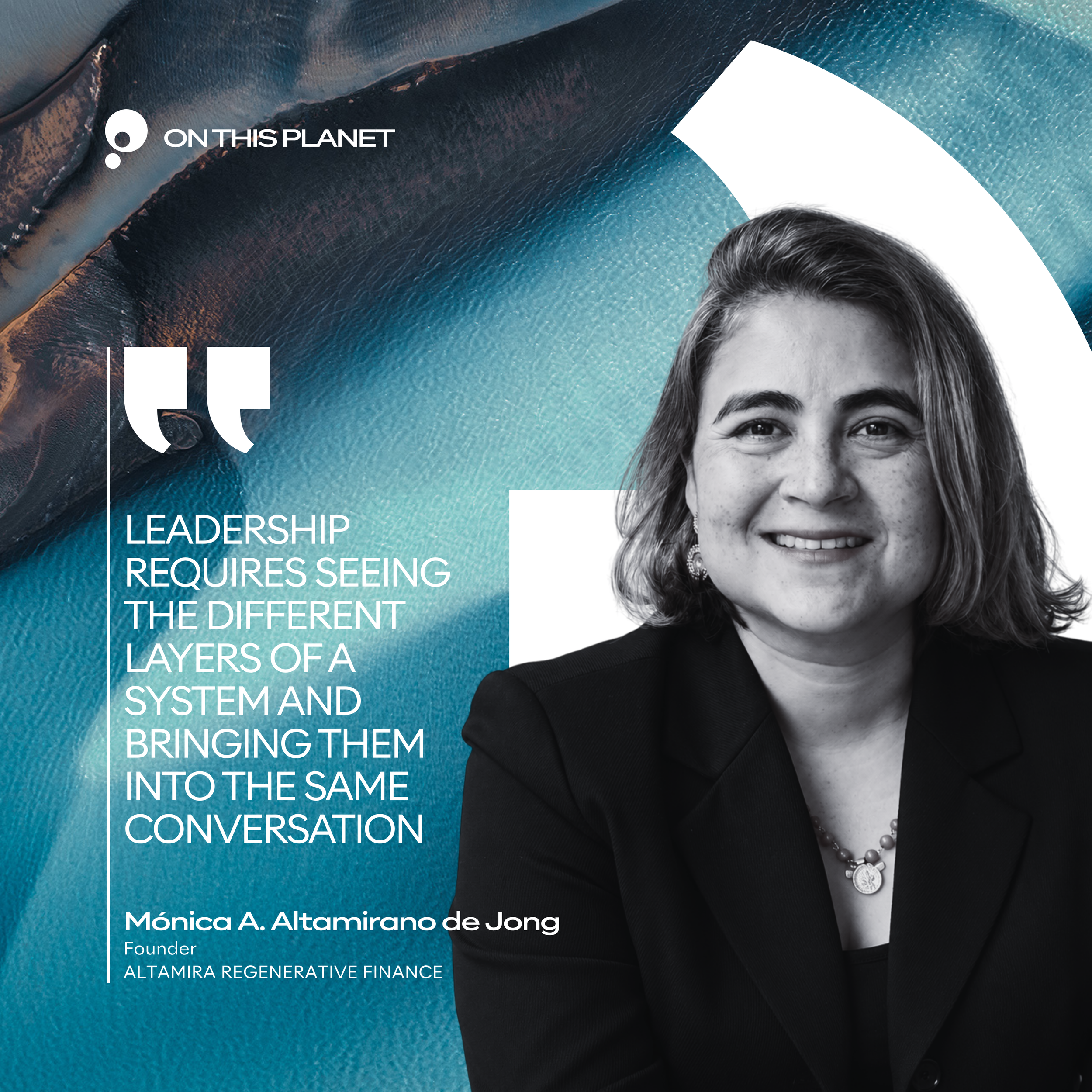
“The role of a leader is to see the different layers of a system and bring them into the same conversation.” This requires analytical ability, but Mónica places equal weight on understanding people. Complex problems bring together individuals with different interests and experiences, sometimes with very different levels of influence. People need to feel able to question assumptions, raise concerns and contribute what they know. She talks about psychological safety, but also uses a much simpler expression: leading from the heart.
Data can tell you a great deal about a system, but people are the ones who have to share what they know, listen to different perspectives and make decisions together.
Trusting What You Cannot Yet Explain
If Mónica could speak to her younger self, she would tell her to take herself less seriously, be more patient and compassionate with herself and worry a little less about getting everything right. Most of all, she would tell her to trust her intuition.
Earlier in her career, she felt that every choice needed to be rationalised and explained. With time, she has learned to pay attention to what experience and instinct are telling her, even when she cannot immediately put the reasoning into words. For someone with a career grounded in engineering, economics and evidence, intuition might seem an unlikely addition. Mónica has not become less analytical. She has become more comfortable recognising that not everything we know arrives neatly packaged as data.
The same openness appears in the leadership she describes. Seeing a system requires expertise, but it also requires curiosity about what you may be missing and an ability to listen to people whose view of the territory is different from your own.