
The Power of Community to Drive Change
In conversation with Marvin Rottenberg, Founder & CEO at Terras
by Raffaella Loncao
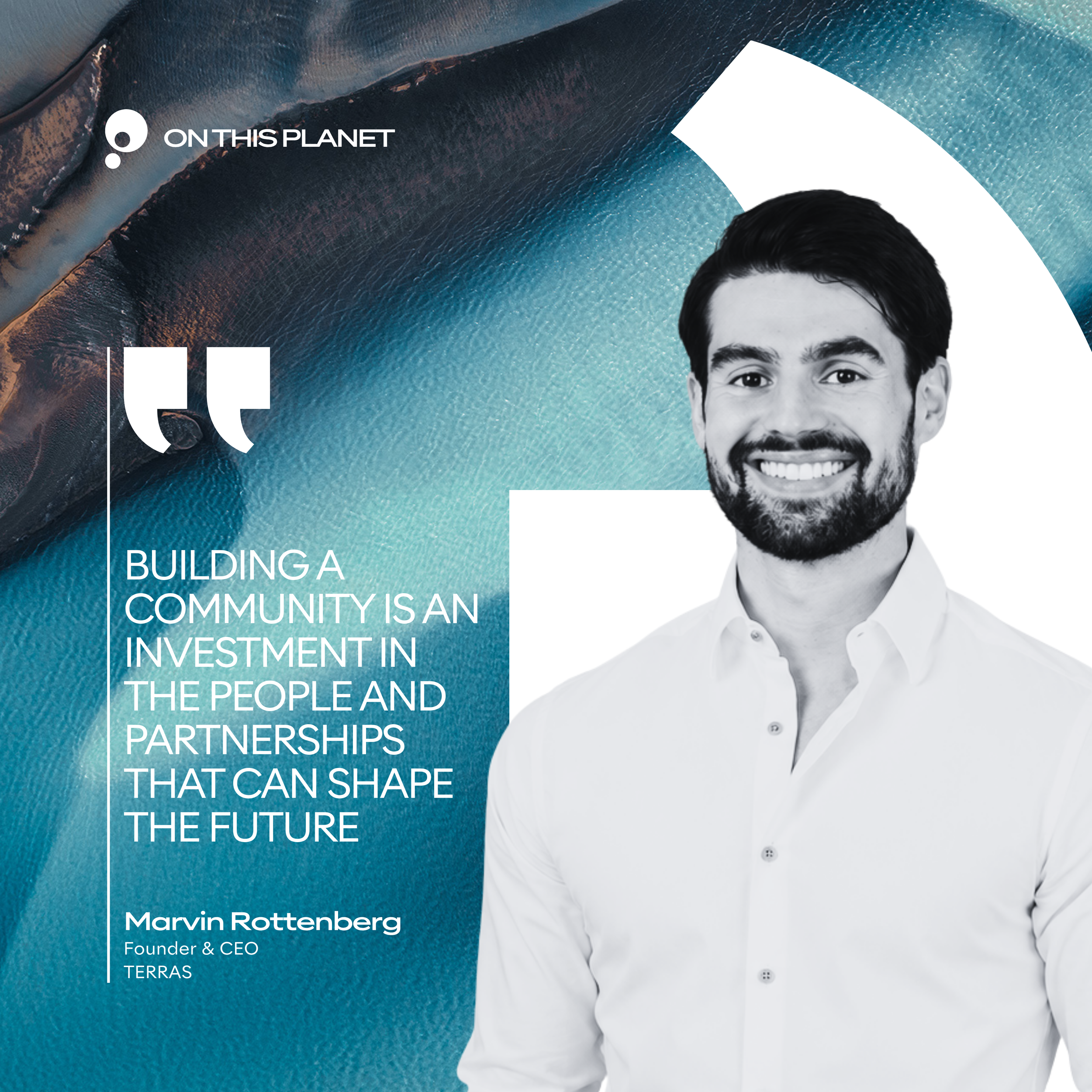
Some of the most meaningful conversations in business continue beyond the main stage. They unfold over dinner and in informal gatherings, where leaders have the opportunity to exchange perspectives, share experiences and explore common challenges in a more personal setting.
Marvin Rottenberg became interested in the value of these exchanges while attending international business events, including gatherings associated with the World Economic Forum. Alongside the formal discussions, he observed how professional connections could develop into more personal conversations about the challenges of advancing sustainability and putting commitments into practice.
This observation would eventually inspire Terras, the global community he founded in 2024 to connect senior leaders across business, finance, policy, philanthropy and sustainability. Behind the initiative is Marvin's conviction that meaningful progress depends not only on the ambitions of individual organisations, but also on their ability to learn from one another and work together.
From Corporate Growth to Entrepreneurship
Marvin did not begin his career in sustainability. After studying Political Economy at the London School of Economics, he joined Google, where he discovered a business culture that encouraged experimentation, initiative and learning from mistakes.
At Google, one of Marvin’s clients was Volkswagen, through the years of the diesel emissions scandal. To push an electric-vehicle strategy forward, he began convening dinners that brought car makers together with urban planners, energy providers, and policymakers, people who were all contributing to the same transition, but approached it from different perspectives and rarely had the opportunity to exchange ideas.
The contrast with the large conferences he was attending was hard to miss. In front of two thousand people, each of them would defend a position.
Over dinner, off the record, they could admit what they did not know and work out where their interests actually overlapped. One evening moved things along more than a year of conferences had managed.
At 28, he moved to a technology start-up as one of its first employees and, as the company expanded, he went on to lead large teams and manage multimillion-euro budgets. The experience gave him considerable responsibility early in his career and reinforced his confidence in pursuing ambitious goals.
But, despite the scale of the projects he worked on, something was missing.
In technology, he explains, the impact of one's work can sometimes feel abstract. Products and services may reach thousands of people without those developing them ever meeting the individuals whose lives they influence. Marvin increasingly wanted to work more directly with people and see what could be achieved through the relationships he built.
That desire, combined with what he had seen years earlier at those dinners, eventually led him to establish Terras.
Through carefully curated gatherings, Terras brings together leaders whose professional paths might not otherwise cross. Both its events and membership are intentionally limited in size, allowing participants to get to know one another and build relationships that extend beyond individual gatherings. Members describe the community as a personal advisory board, a trusted group of people they can turn to for different perspectives, advice and opportunities to collaborate.
For Marvin, building this community has also meant embracing the uncertainties of entrepreneurship. Leaving corporate life required him to exchange financial security for the responsibility of creating something entirely his own. Yet the freedom to pursue a vision he believes in, and to see its impact develop through the people involved, makes the risks worthwhile.
When I ask what advice he would give his younger self, he tells me that he wouldn’t change anything. Every decision, including the mistakes, has contributed to the path he has taken. "Don't be afraid to make mistakes. Everything is going to be alright."
From Business Leadership to Collective Impact
Our conversation turns to the changing expectations surrounding corporate sustainability. At a time when environmental commitments face increasing scrutiny and businesses are under pressure to demonstrate measurable results, Marvin sees an opportunity for sustainability leaders to play an even greater role in shaping business strategy.
He believes that environmental expertise becomes particularly valuable when combined with commercial understanding. Sustainability leaders, in his view, are well positioned to connect environmental and social objectives with the wider priorities of their organisations, demonstrating how investments in areas such as resource efficiency, supply-chain resilience and innovation can contribute to long-term business performance.
This requires the ability to communicate sustainability in terms that resonate across the organisation. Marvin emphasises the importance of clear objectives, measurable outcomes and a shared understanding of how sustainability contributes to business success. Rather than remaining the responsibility of a specialised function, he believes it should become an integral part of how companies make decisions and evaluate opportunities.
However, even the most effective organisations cannot address every challenge independently. Environmental and social issues extend across industries, supply chains and geographical boundaries, often involving stakeholders whose priorities and responsibilities differ considerably.
This is where Marvin sees the greatest potential for Terras. By bringing together leaders from business, finance, policy and philanthropy, he hopes to create the conditions for partnerships that can address challenges beyond the reach of individual organisations. A sustainability executive, an investor and a policymaker may approach the same issue from different perspectives, but their combined experience can reveal opportunities that would otherwise remain unexplored.
For Marvin, the success of Terras is therefore closely connected to the success of its members and the impact they are able to create together. Building such a community requires patience, as trust develops over time and meaningful partnerships rarely emerge from a single encounter.
There is an interesting connection between this philosophy and his earlier career. Having spent years helping technology businesses grow through commercial strategy and measurable performance, he is now applying that same attention to outcomes to something less easily quantified: the value of human relationships.
Marvin's ambition extends beyond creating a network of sustainability leaders. He wants to build a community in which people from different sectors can learn from one another, develop lasting partnerships and contribute to progress on challenges that no single organisation can resolve alone. For him, the measure of success will ultimately be what the community achieves together.