
What Does It Take to Change an Industry?
In conversation with Marie-Claire Daveu, Chief Sustainability and Institutional Affairs Officer at KERING
by Raffaella Loncao
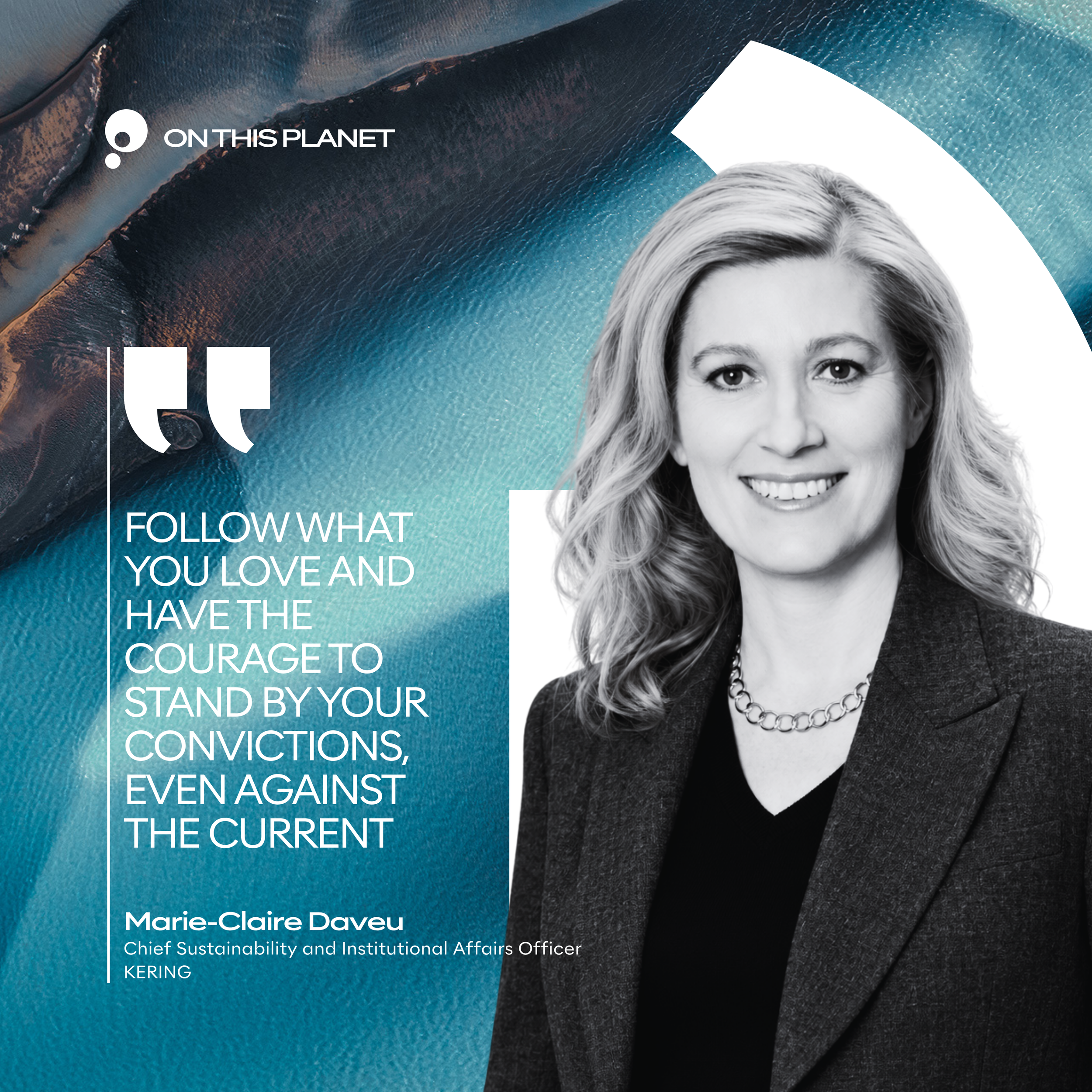
Marie-Claire Daveu is one of those people who are not afraid to make a difference. For her, that can mean challenging some of the most established practices in the luxury industry, including the use of animal fur, or bringing home an injured pigeon she has found on the street. This personal act reflects her core belief: all life deserves respect, whether it is a single animal or an entire species threatened by the consequences of human activity.
Born and raised by the sea in Brittany, Marie-Claire developed a close relationship with nature from an early age. Her mother, a doctor, helped her understand the connection between human health and the environment, while her own fascination with the natural world led her to dream of becoming a biologist. She eventually chose engineering, a path that took her into the French public administration, where she worked on environmental policy before moving into the private sector, driven by a desire to see the concrete impact of her work. Throughout those years, her interest in nature remained a constant, gradually becoming the focus of her professional life.
In 2012, she joined Kering as Chief Sustainability and Institutional Affairs Officer. François-Henri Pinault had already begun placing sustainability at the centre of the Group's transformation, and Marie-Claire was given the responsibility of turning that ambition into an operational strategy across its Maisons. More than a decade later, her tenure serves as a blueprint for transforming an industry whose identity is so closely connected to heritage, craftsmanship and tradition.
Making Sustainability Part of Business Strategy
For Marie-Claire, a sustainability strategy is only as powerful as its governance. To succeed, environmental goals must be treated with the same institutional discipline as financial metrics.
Sustainability cannot be a side project; it must be embedded at every level, starting with the board of directors, and supported by measurable objectives, reliable data, clear accountability, and rigorous performance indicators.
She believes sustainability and financial performance need to be considered together. The challenge is that the two do not always operate on the same timelines. Investments in water or energy efficiency, for example, may take four or five years to generate a return. In an industry accustomed to measuring success over much shorter periods, this requires a willingness to look further ahead and recognise the long-term value of decisions made today.
There is also an important dimension of risk management. Protecting natural resources, anticipating environmental pressures and maintaining responsible business practices are increasingly connected to the resilience of a company and the value of its brands. Marie-Claire is equally clear that sustainability extends well beyond climate and biodiversity. Animal welfare, corruption, bribery and the treatment of people throughout the value chain are all part of the responsibility businesses carry.
The greatest challenge, in her experience, remains change management. People do not always welcome change, particularly when it challenges established ways of working. Transforming an organisation requires patience, the ability to understand different perspectives and a willingness to accompany people through decisions they may initially resist.
It also requires personal conviction. Marie-Claire believes that sustainability leaders must operate with an activist’s determination. You have to be fully convinced of what you are doing, prepared to speak about it repeatedly, build consensus and sometimes fight for what you believe is right, while continuing to work collaboratively with others. She describes the challenge of making climate change, nature and water priorities among all the other priorities competing for attention inside a business.
Having the Courage to Move First
One of the achievements Marie-Claire speaks about with pride is Kering's decision to abandon the use of animal fur. She began advocating internally for the change at a time when fur was still regarded by many as an established expression of luxury. The resistance was considerable, particularly among those who saw it as an essential part of the industry's heritage.
Her conviction came from a concern for animal welfare and the suffering involved in fur production. She continued making the case, despite the difficulty of challenging a practice so deeply embedded in the culture of fashion. Gucci announced its decision to go fur-free in 2017, followed by Kering's commitment in 2021 to stop using animal fur across all its Houses, beginning with the Autumn 2022 collections.
As I hear this story, I imagine Marie-Claire bringing up this topic when nobody else was talking about it, in an industry where traditions are deeply respected and very hard to change. Now I understand what she meant when she said, “you need to be an activist” to work in this field. It takes courage, confidence and determination to question practices that others have accepted for decades, particularly when the commercial implications are uncertain and the wider industry has yet to follow.
In her own words: “Saying things when they are not yet popular.”
Her experience also illustrates how decisions made by influential businesses can gradually change expectations beyond their own organisations. What was once considered a radical position has become increasingly common among luxury houses, including major international fashion weeks joining the likes of London and Copenhagen, with New York Fashion Week implementing its official ban, and Milan Fashion Week most recently announcing it will no longer promote fur at any of its official events.
Another initiative she highlights is the Charter for the Respect and Protection of Models, developed jointly by Kering and LVMH in 2017 and subsequently strengthened. This framework addresses an entirely different aspect of responsibility within the industry: the health, safety, dignity and working conditions of the people who bring fashion to life.
The reinforced commitments include a minimum age of 18 for models representing adults, stronger protections against harassment and abuse, clearer safeguards during shoots involving nudity, and measures to improve reporting and accountability. For Marie-Claire, these initiatives reflect a broader understanding of sustainability that encompasses both environmental responsibility and the treatment of people. They also demonstrate what can happen when competitors agree to establish common standards and use their influence to encourage change across an industry.
Following What You Believe In
As our conversation draws to a close, I think about Marie-Claire’s childhood ambition to become a biologist. Her career took her through engineering, government and eventually luxury, yet she has remained faithful to what inspired her from the beginning: her love of nature and her determination to protect it.
I have always believed that wherever life takes us, we somehow find our way back to the things that matter most to us. Marie-Claire's story is a reminder of how much we can achieve when we remain true to what we believe in, even when the path is not the one we originally imagined.
When I ask what advice she would give to the next generation of leaders, her answer reflects the spirit that has guided her own career: “Follow what you love and have the courage to stand by your convictions, even when it is difficult. Do what you believe is right.” Above all, she believes you should be able to look at yourself in the mirror and feel proud of what you have done.