
Why the Future of Sustainability Leadership Starts With Empathy
In conversation with Lauren Bartley, Chief Sustainability Officer at GANNI
by Raffaella Loncao
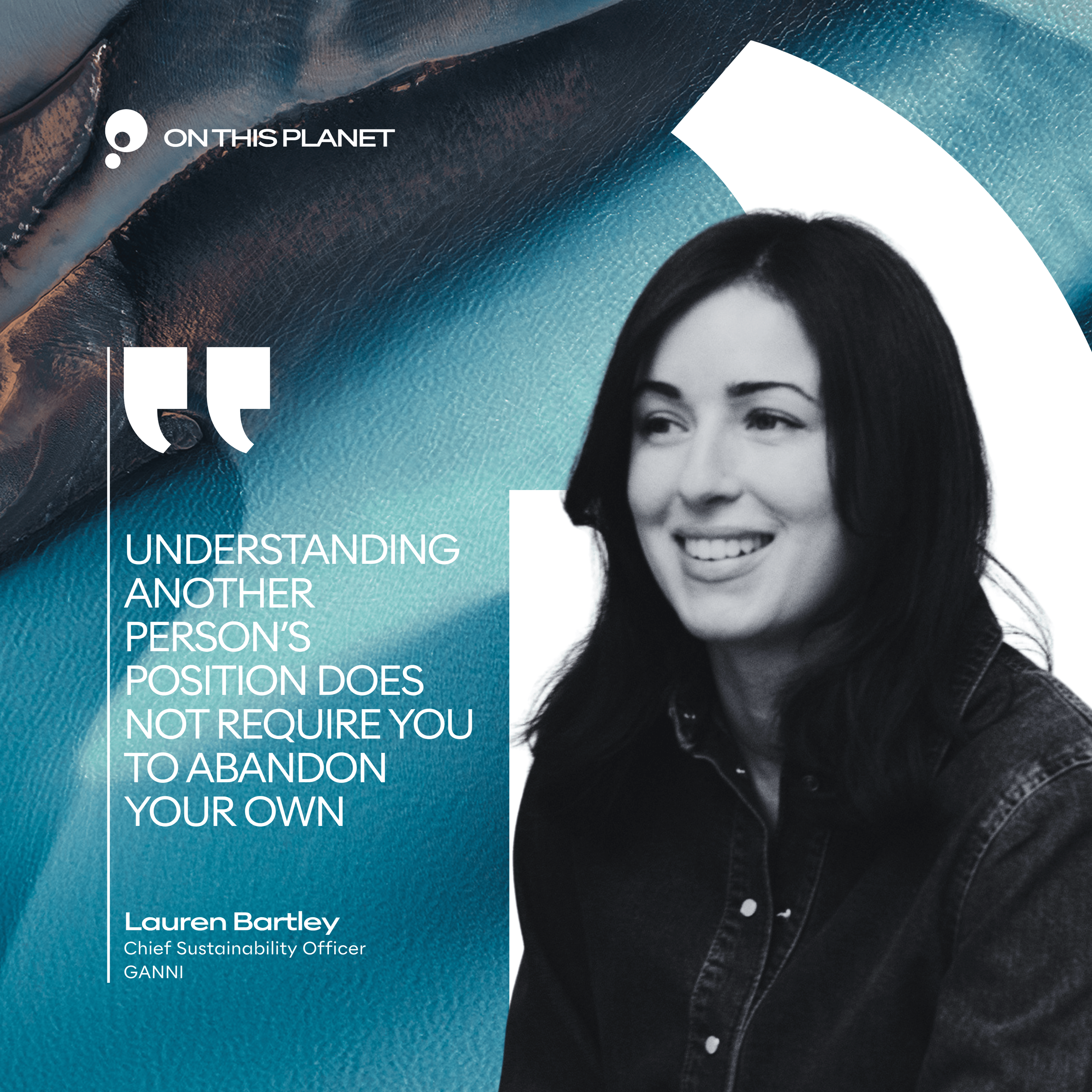
Sometimes the most important career decisions are the ones made for us.
For Lauren Bartley, a door closing early in her career unexpectedly put her on a path that would eventually lead to GANNI, where she joined the Danish fashion brand as Head of Sustainability in 2018. A year later, GANNI formalised its sustainability ambitions with the launch of its first GANNI Gameplan, a framework designed to translate environmental and social ambitions into concrete goals and accountability across the business.
Over the years, the Gameplan has evolved alongside GANNI itself. Its scope has increasingly moved beyond the footprint of individual products towards the role the company can play in changing the wider fashion system, through its own operations as well as the materials, technologies and partnerships it chooses to support.
Lauren’s experience over those years has also shaped a clear view of what makes sustainability work inside a business. One of the biggest obstacles, she believes, is still the tendency to treat it as a separate function rather than part of the way the company operates.
A sustainability team can set ambitious targets, but delivering them requires an understanding of how a fashion business actually works: what drives commercial decisions, where the operational pressures sit, what different functions are trying to achieve and who ultimately decides what gets prioritised. Sustainability leaders therefore need business fluency alongside technical expertise if they want to influence those decisions.
Sustainability, in Lauren’s view, needs to become part of the business strategy itself.
Curiosity Before Judgement
Ask Lauren what makes someone successful in sustainability and three qualities emerge: curiosity, empathy and compromise.
They become particularly visible when the conversation turns to some of the resistance sustainability leaders are encountering today. Faced with a provocative comment such as “Nobody cares about sustainability anymore,” her instinct is to understand where it is coming from rather than immediately challenge it.
She wants to know the person’s context, what pressures they are facing and what experiences have led them to that conclusion. A CEO dealing with difficult business conditions, for example, may be looking at sustainability through a very different lens from someone whose role is dedicated to delivering an environmental agenda.
As sustainability becomes more politicised and businesses operate under greater economic and commercial pressure, this ability to understand different perspectives becomes increasingly relevant. Progress depends on working with people who may have different priorities, incentives or levels of conviction.
Lauren remains clear about the outcome she wants to achieve, while staying open to the perspective of the person sitting opposite her.
Empathy and Determination
If there is one leadership quality she believes will become increasingly important in the years ahead, it is empathy.
It is also something that comes through strongly in conversation with her. Her communication is calm and considered, yet there is nothing hesitant about it. She listens carefully, makes her point clearly and does not appear to see kindness and determination as competing qualities.
That combination is particularly relevant in sustainability, where leaders are often trying to influence people over whom they have little direct authority. They have to work across functions, reconcile competing priorities and build support for decisions that may involve cost, complexity or changes to established ways of working.
For Lauren, compromise is part of that process. It means understanding how to bring people with you while remaining clear about the ambition.
Learning How Not to Lead
Her own leadership philosophy was shaped by great mentors, but also by some of the management she encountered earlier in her career.
“A lot of what I learned about what kind of leader I wanted to be came from observing the leaders I knew I did not want to be like.”
Those experiences gave her a reference point for the behaviours she wanted to carry forward and those she did not. Leadership, in that sense, was something she learned through observation as much as through formal development or positive role models.
Looking back, she also remembers a younger version of herself who was brave. Some of that, she thinks, came from a certain naivety: she was willing to say very clearly what she wanted and what she did not, without always calculating how those views might be received.
There is an interesting confidence in that younger version of herself, that came before experience introduced all the reasons to be more cautious.
From Reducing Impact to Changing the System
Lauren’s combination of conviction and pragmatism is also reflected in the evolution of GANNI's sustainability strategy.
The company's ambitions increasingly extend beyond reducing the environmental footprint of the products it puts into the world. GANNI has been exploring the role it can play in accelerating change across fashion itself, including through next-generation materials, new business models and partnerships with organisations developing alternatives to established ways of producing fashion.
This reflects a broader evolution in the industry. For years, much of the sustainability effort has understandably concentrated on reducing emissions, improving materials, managing waste and addressing the impacts generated through existing supply chains. Those efforts remain essential, but companies are also beginning to consider how their influence can support changes beyond their own immediate footprint.
No individual fashion brand can transform the system alone. It can, however, make decisions about where it invests, which innovations it supports, what it asks of suppliers and how it uses its position in the market.
For sustainability leaders, this expands the scope of the role. Technical expertise remains important, but so does the ability to understand the commercial and organisational context in which change has to happen.
A Different Definition of Success
After years spent navigating one of fashion's most complex challenges, Lauren’s own definition of success is “being proud of what you have accomplished and finding alignment between your values and what you are trying to achieve”.