
Why Lasting Change Is Never Achieved Alone
In conversation with Iris Van der Veken, Executive Director at Watch & Jewellery Initiative 2030
by Raffaella Loncao
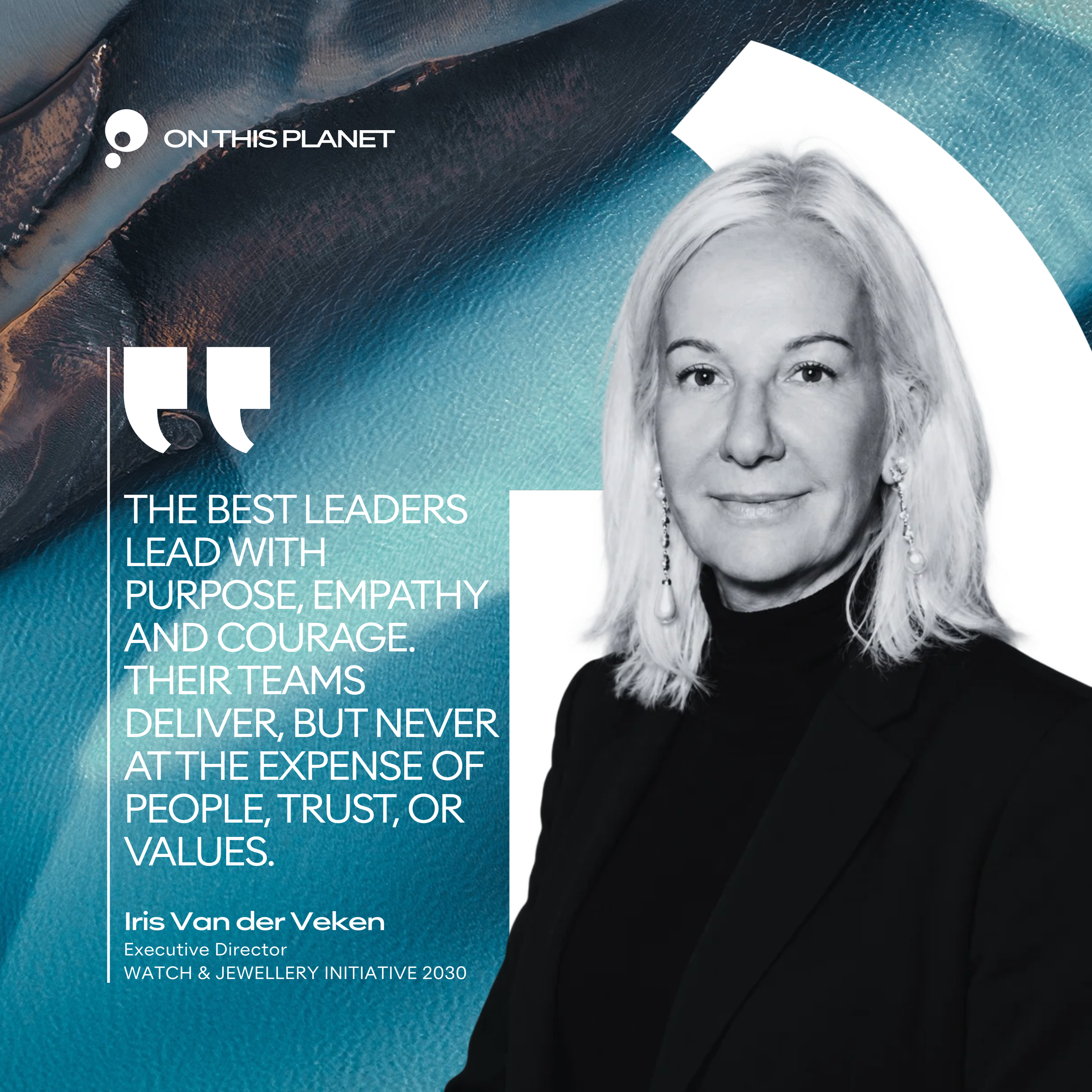
The first time I met Iris Van der Veken was during a business video call in February 2022, when she was navigating a crisis. I watched her remain composed through a difficult moment, and although I have never told her this, I admired her courage and her willingness to be in the arena when leadership was anything but comfortable.
It would not be the last time Iris inspired me or showed me what is possible when passion, purpose and expertise come together.
The next time I found myself thinking about possibility was when I watched her speak at the United Nations Forum on Business and Human Rights. By then, Iris had spent much of her career working across the world, from factories and supply chains to boardrooms and international institutions. Yet for someone whose professional life has taken her into increasingly visible positions, there is remarkably little interest in making the story about herself.
That was not always how she thought about success.
In her twenties and thirties, Iris describes herself as a high achiever, driven by performance and personal and professional accomplishment. Today, her definition has expanded considerably. Success is about collective achievement and what becomes possible for other people as a result of your own progress.
“Nobody can be successful on their own. I want to lift people around me as I grow.”
Leaving a legacy through purpose and impact now matters to her far more than any individual achievement.
Learning Leadership on the Ground
Long before sustainability became an established corporate function, Iris was working on the realities behind it.
She spent more than a decade with Rosy Blue, initially in human resources and later leading global corporate affairs. Her work took her across India, China, Japan, the United States, South Africa, Thailand, Sri Lanka, Israel, Armenia, the UAE and Belgium, directly into factories and supply chains at a time when many of the structures now associated with responsible business were still being developed.
She worked on issues ranging from working conditions and environmental management to governance and responsible sourcing, and was involved in developing and piloting standards for the Responsible Jewellery Council. The experience gave her an unusually practical understanding of the relationship between social and environmental responsibility and the way a business actually operates.
Working close to production also taught her that decent working conditions, talent retention, effective management and business performance cannot easily be separated. Sustainability was not an abstract principle discussed from headquarters; she could see its consequences in the lives of people and in the performance of the organisations employing them.
Those years also coincided with a more personal journey, as Iris worked to understand herself and establish her own identity through some of the difficult challenges life placed in front of her.
If she could speak to the younger woman she was then, her advice would be:
“Be bold. You are more than enough. Don’t be afraid to shine.”
It is something many women will recognise as we continue to navigate a society in which gender parity remains a distant prospect. For Iris, learning to trust her own voice became part of the same journey that would eventually take her into increasingly visible leadership positions.
From Ambition to Action
Today, Iris leads the Watch & Jewellery Initiative 2030, where much of her work is focused on a problem that extends far beyond watches and jewellery: the distance between corporate ambition and implementation.
Companies are facing growing expectations around climate, nature, human rights, inclusion, traceability and transparency. The difficulty, particularly for smaller businesses and suppliers, is turning those expectations into something they can actually implement without becoming overwhelmed. Iris believes they need practical tools, shared expertise and support rather than another layer of frameworks.
She sees a familiar pattern. Sustainability remains too often a side function rather than a business function, disconnected from procurement, finance, sourcing, product development and commercial decision-making. Short-term financial pressures compete with investments whose value may emerge over a much longer horizon, while business models and supply chains designed for a different era are expected to deliver very different outcomes.
“Reporting should be the outcome of action, not the starting point.”
Her argument is practical. If sustainability is treated primarily as reporting, communications or compliance, it will remain peripheral to the decisions that determine how the business operates. Integration requires clear ownership, reliable data and measurable targets, but also people across the organisation who understand how those commitments affect the choices they make.
This is also where WJI 2030 has concentrated much of its work. Its objective is not to reinvent what already exists, but to bridge the gap between ambition and implementation through practical guidance, capacity building and collaboration. Its work includes resources covering climate, nature and human rights, alongside specific support for SMEs.
The Nature Roadmap and Action Playbook, Climate Change Navigator and SME Climate Toolkit, Human Rights Navigator and gender-equality frameworks developed with UN Women are examples of what this looks like in practice. Rather than expecting each business to find its way independently through increasingly complex challenges, the initiative creates tools that companies can use and adapt to their own circumstances.
For Iris, this is what collective action looks like when it moves beyond declarations.
The Case for Collective Action
When I ask Iris which leadership capability will matter most over the next five years, she talks about the ability to build trust and mobilise collective action across boundaries.
The problems she works on do not sit neatly within one organisation. Climate, biodiversity, human rights and supply-chain challenges move between companies, suppliers, policymakers, investors and communities. No CEO, sustainability team or individual business controls the entire system in which they operate.
This changes what leadership requires. Progress depends on bringing people with different interests and levels of influence around the same table, listening to perspectives that may challenge your own and finding enough common ground to move forward.
Iris has been working this way for much of her career. During her years in the diamond industry, she saw shared standards being developed and then confronted the harder question of how to make them work in practice. Later, as the first Chair of the UN Global Compact Network Belgium, and now through WJI 2030, coalition building became increasingly central to her work.
Her experience has convinced her that lasting change cannot be achieved by an individual organisation acting alone. It requires businesses, suppliers, policymakers, investors, civil society and communities to find ways of working towards common goals, even when their interests and starting points are different.
What the Future of Luxury Could Look Like
Iris has a perspective on the future of the industry that gives me hope.
She believes we will see a shift towards craftsmanship, innovation and cultural relevance. A beautiful handbag, watch or piece of jewellery on its own may no longer be enough if the brand and the product are not connected to a positive story behind them.
For an industry built on exceptional products, this does not mean moving away from beauty or desire. It means expanding the definition of what makes something valuable.
“The ultimate expression of luxury today is trust. When consumers trust the provenance of a product, the values of a brand, and the integrity of the people behind it, luxury becomes more than a product. It becomes a lasting relationship. Luxury is increasingly about how something makes people feel rather than what it signals to others.”
Iris has spent enough time inside supply chains to know how much knowledge, human skill and natural capital sit behind a finished object. Bringing those elements closer to the way brands define value could create a different relationship between sustainability and luxury, one in which responsibility is part of the quality and relevance of the product rather than an additional story attached to it.
It also requires businesses to think beyond the next reporting cycle or quarterly pressure. Supply chains, capabilities and business models take time to redesign. The tension between that long horizon and the immediate pressures facing executives is one of the reasons Iris believes shared tools and collective action matter: not every company needs to solve every problem from the beginning on its own.
Don’t Be Afraid to Shine
Towards the end of our conversation, we return to the idea of success.
The younger Iris measured it through performance and achievement. The woman I know today speaks instead about the people she can lift, the partnerships she can build and what remains after an individual leader has moved on.
Her mother and grandmother were important influences in shaping that outlook. She describes them through qualities that also appear repeatedly when she talks about leadership: courage, humility, hard work and kindness. Her own career has added another layer to that inheritance, built through years of working across countries, cultures and parts of the value chain where leadership decisions eventually become real.
When Iris tells me that nobody can be successful on their own, it does not sound like a leadership principle she has adopted for an interview. It sounds like something she has learnt over decades of seeing change happen, or fail to happen, in the real world.