
Redefining the Role of the Fashion Designer
In conversation with Eugène Riconneaus, CEO & Founder at ER Ocean Recherche
by Raffaella Loncao
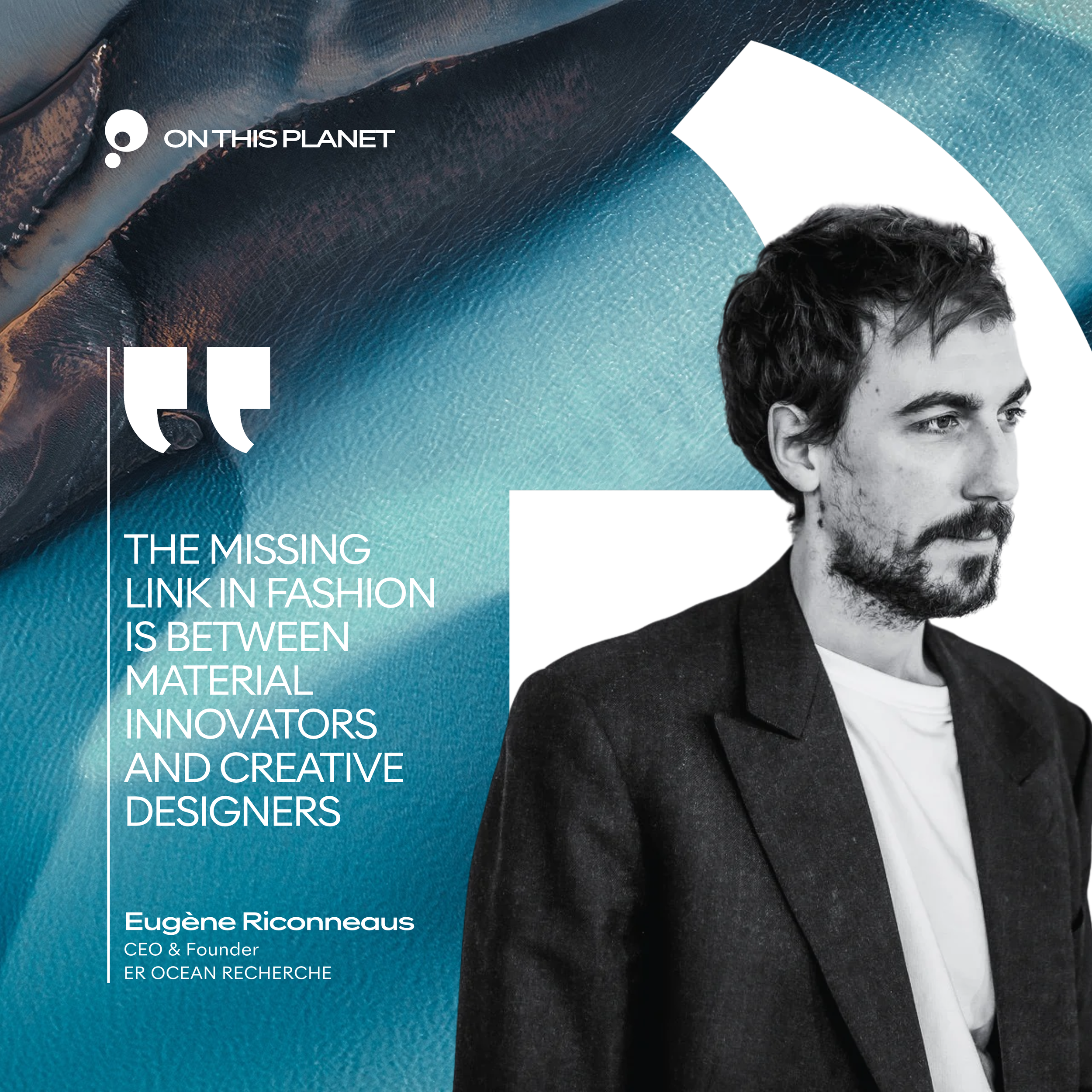
Eugène Riconneaus is not someone who can easily be defined by a professional title. An artist, fashion designer, entrepreneur and, more recently, material innovator, he has built a career around exploring the relationship between creativity and the natural world. When I ask how he would describe himself, he tells me that he doesn't particularly like definitions, but if he had to choose, it would be artist or creative director.
Born into a fishing family in La Rochelle, on France’s Atlantic coast, Eugène grew up with a close connection to the ocean, which has remained a constant source of inspiration throughout his career. At 18, he created his first fashion collection using upcycled materials before establishing himself as a footwear designer. His creations gained international recognition, with collections sold through prestigious retailers and collaborations with established fashion brands.
His work has since taken him from fashion into art, chemistry and biotechnology, a journey that led to the creation of ER Ocean Recherche, a company developing innovative textile materials derived from marine resources.
What fascinates me about Eugène is the way he combines artistic ambition with scientific curiosity and an entrepreneurial determination to turn his ideas into reality. He speaks about the ocean almost as a creative partner, describing water as the origin of life and the foundation of his work. His ambition is to create a fashion collection entirely from materials originating in the sea, bringing together everything he has learned as a designer, artist and founder.
From Fashion Design to Material Innovation
Eugène's interest in material science developed during a period of personal reflection. Having spent years building his footwear collections and working with international retailers, he began questioning what he wanted to create next and whether continuing along the same path would bring him the same sense of fulfilment.
Rather than develop another collection, he started experimenting with chemistry to create the materials he wanted to use in his artwork. What began as an artistic exploration gradually developed into a scientific research practice, involving marine biomass, natural pigments and new forms of textile production.
His research has taken him into laboratories and academic institutions, including Sorbonne Université, where he has developed relationships with scientists and researchers. He has also shared his work and experience through institutions including Cornell University, MIT and the Institut Français de la Mode.
Today, through ER Ocean Recherche, he and his team are developing materials from marine resources such as algae and seafood by-products. Among the innovations are SeiFibre silk-like fiber made from 100% seaweed spun into yarns and fabrics that can be used as an alternative to conventional petro-based fiber,
This approach was illustrated by Ocean Apocalypse, a couture dress presented at the Grand Palais in Paris in 2026 (during ChangeNOW), bringing together years of marine-material research in a finished creation.
He is fascinated by the colours and light found beneath the ocean’s surface, from marine pigments to the extraordinary ability of certain organisms to produce their own light through bioluminescence. For Eugène, these natural phenomena open up entirely new possibilities for creating materials, textures and colours.
It’s incredible to think how closely art and science are connected, and how both disciplines depend on curiosity, experimentation and the willingness to explore what does not yet exist. For Eugène, this journey has also changed his understanding of the designer's responsibility. He believes that the creative process should begin much earlier than the sketching of a garment, at the level of the materials themselves. As he puts it: “a creative director of the future should be able to start at the micron scale”.
Bringing Innovation into the Creative Process
One of the greatest challenges Eugène identifies is the distance between the people developing new materials and those responsible for creative direction within fashion houses. He believes that the industry has made considerable progress in material innovation; however, many promising developments struggle to find their way into actual collections. Sustainability and innovation teams may be familiar with new fibres and technologies, but creative directors are often involved too late in the process to understand their possibilities or incorporate them into their designs.
The problem, in his view, is partly one of communication. Scientists understand the technical properties of the materials they develop, while designers need to understand how those materials can be transformed into something beautiful, desirable and relevant to their creative vision. Eugène believes there is a missing link between these two worlds, and sees his own experience as an opportunity to help bridge that gap.
Through ER Ocean Recherche, he is developing not only new materials but also finished fabrics and garments that demonstrate what can be achieved with them. His ambition is to give designers something tangible to work with, allowing them to explore the creative potential of innovation without having to begin the development process from scratch. This approach was illustrated by Ocean Apocalypse, a couture dress presented at the Grand Palais in Paris in 2026, bringing together years of marine-material research in a finished creation.
He explains that developing a new fibre is only part of the challenge. The real value lies in understanding how it can be processed, manufactured and transformed into a product that meets the expectations of the fashion industry. His ambition for ER Ocean Recherche is to develop into a textile house, connecting biotechnology and material innovation with European manufacturing expertise and craftsmanship.
The Entrepreneur Behind the Artist
Finance has never been something he particularly enjoyed, but becoming an entrepreneur required him to embrace it. He challenges the idea that creativity and business should remain separate, referring to artists such as Andy Warhol, who understood that commercial success could also help bring their creative vision to a wider audience.
For Eugène, building a company is part of the creative process. As founder and CEO, he works on partnerships, manufacturing, investment and the development of the infrastructure required to bring new materials to market. He is also convinced that the transition towards more responsible materials will require greater collaboration across the industry. Research takes time, and innovations are often developed independently, with limited opportunities for designers, scientists and manufacturers to share their knowledge. He wants ER Ocean Recherche to become part of a wider community of innovators, helping accelerate the development and adoption of new materials.
Eugène draws inspiration from creative visionaries such as Virgil Abloh and Massimo Osti, who challenged conventions by bringing together different disciplines, ideas and communities. He admires their curiosity and willingness to experiment, and wonders what a designer like Osti might have created with access to the materials and technologies emerging today.
Returning to Fashion with a Different Perspective
Eugène has always felt like an outsider. In fashion, he was considered an artist; in art, a designer; and now, after years of scientific research, people increasingly see him as a scientist. Yet he has never stopped thinking of himself as a creator. He describes his professional journey as a spiral rather than a straight line, returning repeatedly to the same interests while approaching them from different perspectives. What initially appeared to be a departure from fashion has ultimately brought him closer to understanding the very foundations of what he wants to create.
His ambition now is to return more fully to creative direction, bringing his knowledge of material science into the development of fashion collections and, eventually, the creative leadership of a house. He believes that the next generation of creative directors will need to understand innovation much further upstream in the value chain, working alongside scientists, manufacturers and craftspeople to imagine new possibilities for design.
Eugène's journey is a clear example that our professional paths do not always follow the direction we originally imagined. Sometimes, exploring an entirely different discipline can deepen our understanding of what we have always wanted to do. For him, the years spent in the laboratory have become part of his creative education, giving him a new perspective on the role designers can play in shaping the future of fashion.