
Sustainability Needs Translators
In conversation with Camille Herry, Corporate Social Responsibility Director at Chargeurs PCC Fashion Technologies
by Raffaella Loncao
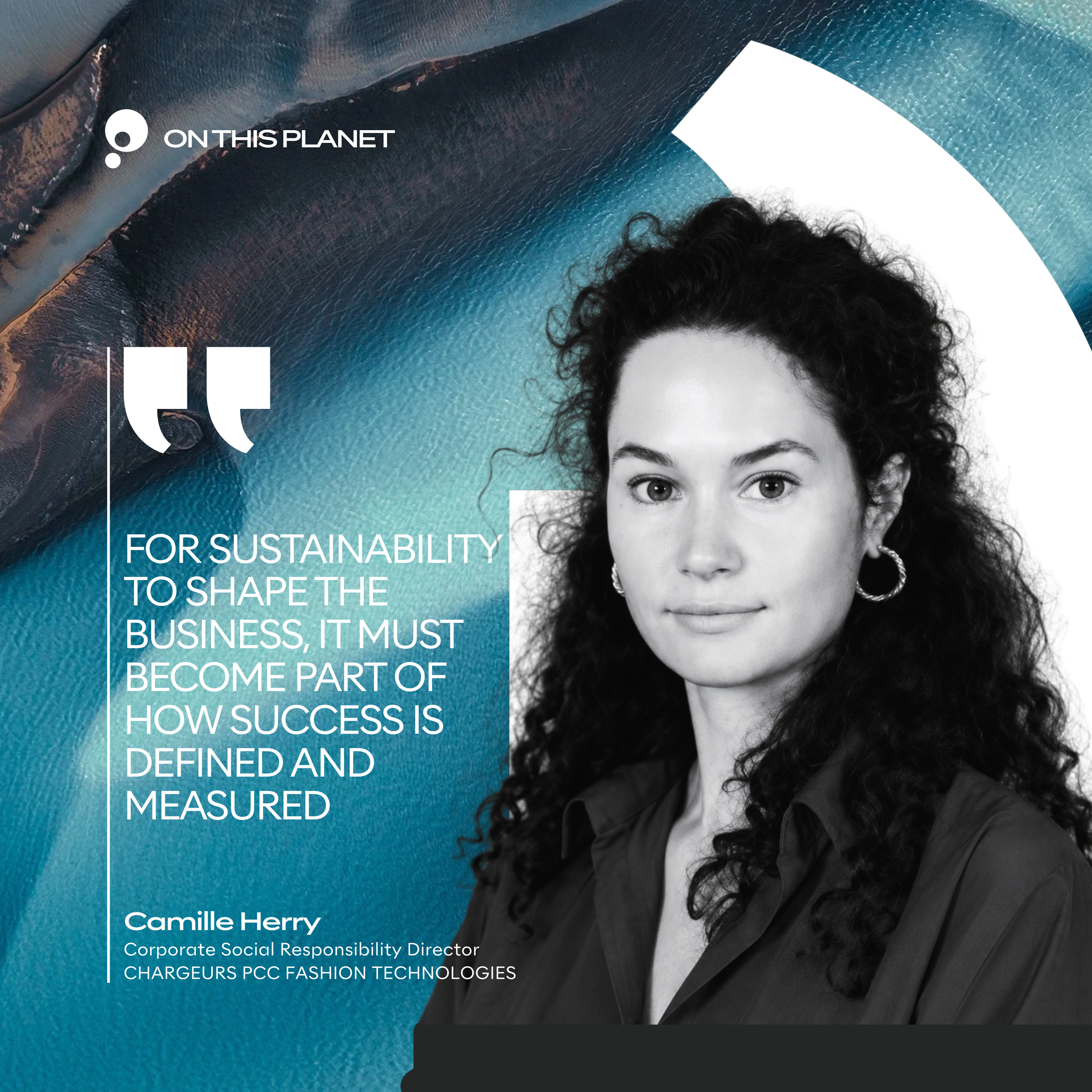
Camille Herry joins our call from a café in Bangkok, so we begin our conversation with an easy piece of common ground: we both love this city.
Exploring the world has been a recurring theme in Camille’s life, and fashion has been part of it from an early age, when she developed a fascination with design and craftsmanship that eventually took her to Scotland to explore tweed and wool farming.
Today, as Deputy Chief CSR Officer at Chargeurs PCC Fashion Technologies, her work sits much further upstream in fashion’s value chain, within the industrial system behind the finished garment. That vantage point has given her a particular perspective on how sustainability has evolved over the course of her career.
Years ago, she recalls, the industry often approached sustainability primarily as a communication topic: something a company could talk about and consumers could feel good about buying. The conversation today is very different. When sustainability is properly integrated into a business, it can contribute to innovation, resilience, competitiveness and value creation.
For Camille, understanding that shift also changed the direction of her career.
Going Upstream
After completing an Executive MBA in Global Fashion Management at Institut Français de la Mode, she reached a turning point. A conventional route into one of the fashion brands she had always admired was available, but another question had begun to interest her: how could innovative solutions be scaled within an industry built around complex global supply chains?
The further upstream you travel in fashion, the more complex that process becomes. A designer may begin with an idea for a beautiful garment, but delivering it involves raw materials, chemistry, suppliers, factories, technical capabilities, cost and environmental impact.
At one point in our conversation, Camille takes me back to the product itself. She describes the feeling of wearing a beautiful cashmere cardigan, responsibly made, soft against the skin, comfortable and durable enough to remain in your wardrobe for years.
Her love of fashion comes through immediately, in her words and in the way her expression changes as she talks about it.
“I don’t think sustainability should require us to stop loving fashion. The interesting challenge is preserving creativity and desire while transforming the systems behind them.”
Her work has developed in the space between those two ambitions: preserving the creativity and pleasure of fashion while changing the industrial systems required to produce it.
The Leaders Who Can Translate
When I ask which quality will become increasingly important for impact leaders, Camille chooses agility.
She talks about agility as the ability to navigate constant change and move between different worlds, adapting to the context without losing sight of the objective.
“A carbon engineer does not speak the same language as a creative director.”
Technical expertise alone will not necessarily persuade a creative team, just as a compelling vision will not solve an engineering problem. Someone has to understand enough of both worlds to connect them.
For Camille, successful impact leaders need to be comfortable moving across different contexts.
The work behind that ambition remains highly practical. Sustainability involves industrial capacity, chemical management, decarbonisation and responsible supply chains. Leadership determines how those technical realities travel through an organisation and reach the people making decisions.
Before Another Dashboard, Look at the Decision
That brings our conversation to the growing volume of ESG data, reporting requirements, targets and dashboards that organisations are now expected to manage.
A company may have an extensive sustainability roadmap, but its influence will remain limited if the people making decisions about sourcing, investment, product development or operations are measured against objectives that point in other directions.
The questions she raises are practical ones. Who owns the sustainability roadmap? What happens when an environmental objective conflicts with a commercial target? Are sustainability KPIs included in leaders’ objectives? Do incentives reinforce the commitments the organisation has made?
This is where sustainability moves from roadmap to operating reality. KPIs and incentives shape priorities, and priorities influence the decisions people make when there are competing demands on time, money and resources.
For sustainability to become structurally embedded, it has to enter those mechanisms and become part of how the business defines and measures performance.
The Economics of Change
Internal decisions are only one part of the picture. Cost, changing client expectations and regulation are also altering the conditions in which companies operate.
Economics remains a powerful lever. When a more sustainable solution becomes commercially viable, easier to scale or increasingly expected by customers, the barriers to adoption begin to change.
In Europe, regulation is accelerating the transition towards a more circular textile economy, with growing requirements around durability, repairability, recyclability, transparency and producer responsibility.
This broader relationship between business and public policy is also shaping the next stage of Camille’s thinking. She is returning to study at Sciences Po to explore governance and public policy more closely, and how they can support business transformation.
At the same time, Camille sees significant movement in Asia, where much of fashion’s manufacturing and supply-chain infrastructure is located.
Her international perspective makes the geography of sustainability particularly tangible. Strategies and regulatory frameworks may be developed in Europe, while many of the changes required to deliver them have to happen across factories, suppliers and industrial partners thousands of kilometres away.
For leaders operating across that system, the ability to translate again becomes relevant: between corporate ambition and industrial reality, different markets, and the people responsible for turning commitments into physical products.
Beyond the Supply Chain
Eventually our conversation moves beyond how fashion is made to how much of it we consume.
Better materials, cleaner processes and more responsible supply chains can reduce impact, but growing volumes of products continue to put pressure on the system. Responsibility therefore extends beyond companies and into the way society consumes.
Camille sees education as an important part of changing that relationship. ESG, in her view, has a broader role than regulation and corporate compliance. It can contribute to how people think about resources, value and consumption, particularly among generations that will inherit both the consequences of the current system and the responsibility for changing it.
Her interest in education has also brought her into contact with students at Institut Français de la Mode, including through projects exploring regenerative agriculture and wool and connecting students more closely with the farms, materials and industrial processes behind fashion.
Don’t Confuse Elegance With Certainty
Early in her career, Camille remembers looking at people around her and assuming that they knew exactly where they were going.
Experience gradually changed that perception. She realised that many of the people she admired were also navigating uncertainty, making choices as opportunities appeared and adjusting direction along the way.
Her advice to the next generation entering that environment, is to “be weird”, maybe a way of telling them not to assume that the most interesting career will follow the most obvious route.