
Understanding the Financial and Economic Dimensions of Sustainability
In conversation with Benedicta Banga, Director & Chair of Women in Sustainable Luxury
by Raffaella Loncao
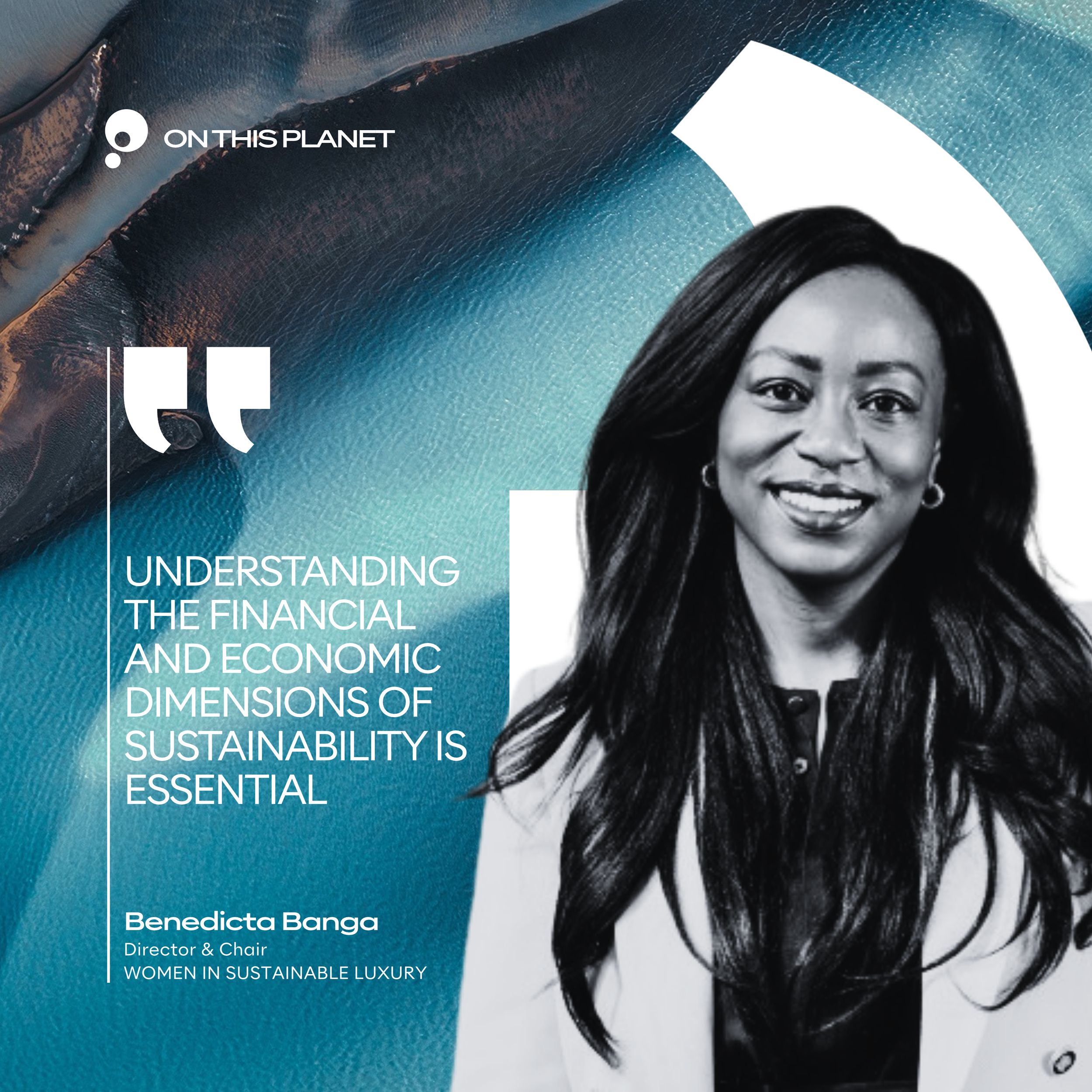
Benedicta Banga and I first started exchanging views on leadership and mentorship early last year. She had recently launched Women in Sustainable Luxury and was building a community around a shared mission: bringing together women working to shape a more sustainable future for the luxury industry.
It was an idea that had emerged gradually from her own career. Benedicta had spent years working across technology, innovation and business transformation, largely in environments where women were underrepresented.
As her interest in sustainability grew and she began exploring the relationship between technology, innovation and environmental progress, she found herself surrounded by many more women and started thinking about what might be possible if they had a stronger network through which to exchange knowledge, increase their influence and support one another.
Women in Sustainable Luxury grew from that idea and today brings together leaders from fashion, beauty, jewellery and other parts of the luxury value chain. The community also gave a more formal expression to something Benedicta had been doing for years. Throughout her career, she has gravitated towards mentoring, sharing what she knows and spending time with graduates and younger professionals. She recognises something of her younger self in them and wants to give them access to people, perspectives and opportunities she did not necessarily have at the same stage.
Her desire to create that access for others comes at a point in her own life when her understanding of success has changed considerably.
Growing up, she absorbed a fairly traditional idea of what it meant to succeed, closely associated with financial achievement and the material signs that came with it. Money still matters to her, but it no longer tells the whole story. She talks instead about building something she is proud of, having greater freedom over where she puts her time and energy, creating a legacy and helping other people progress along the way.
That ability to hold different measures of value at the same time also comes through when we talk about sustainability and business.
Speaking the Language of Business
Benedicta does not see environmental and social impact as separate from business performance. Her interest lies in how the two can be brought together, particularly when sustainability ambitions have to compete for investment and attention alongside the many other priorities inside an organisation.
“We cannot afford to overlook the financial and economic dimensions of sustainability.”
For her, this means being able to move comfortably between the environmental or social case for change and the commercial questions that will inevitably follow. Profitability, investment and return are part of that conversation because they influence whether an organisation is prepared to commit resources and how quickly an ambition can move from intention into execution.
The growing scrutiny around ESG has only made that connection more relevant. Broad commitments that might once have been enough to secure support are increasingly being questioned, and the ability to demonstrate how sustainability contributes to the business has become more important. Regulation is creating stronger expectations around environmental impact, transparency and supply chains, but regulation cannot make every commercial decision for a company.
Fashion makes this tension particularly visible. Over several decades, businesses have become extraordinarily effective at making supply chains faster and more cost-efficient. Benedicta is interested in what disappeared from the equation as cost and efficiency became dominant measures of a good decision. The environmental and social consequences did not disappear simply because they were absent from the calculation, and bringing them back into the way decisions are made requires people who can understand the different forces acting on the business and make a persuasive case for change.
Her background in technology makes our conversation about artificial intelligence feel like a natural extension of the same question. If sustainability leadership increasingly depends on making sense of competing information and priorities, what happens when access to information itself becomes almost universal?
Research that once required considerable time to find, organise and digest can now be accessed and synthesised in minutes. Benedicta believes this will make agility and critical thinking more valuable, because access to an answer tells us very little about what someone will do with it. Leaders still have to question the information in front of them, understand what is relevant to their particular context and recognise what may be missing before deciding how to act.
The risk is that we become overly dependent on technology, and that people using the same tools and drawing from the same pools of information will arrive at increasingly similar conclusions. Original thinking then depends on the quality of our judgement and on our willingness to expose ourselves to perspectives that challenge our own.
The People Around the Table
When I ask Benedicta what she would tell her younger self, her answer is to surround herself earlier with people from different walks of life. Looking back, she sees how much her own thinking was expanded by people whose careers, backgrounds and experiences were different from hers, particularly those who challenged assumptions she might otherwise have carried without noticing them.
“I intentionally seek to understand people with perspectives that differ from mine.”
She is not interested in disagreement for its own sake. What she values is the opportunity to understand why another person sees something differently, which requires enough curiosity to listen before trying to persuade. In a world where information is becoming easier to obtain, another person’s experience remains much harder to replicate.
It brings us back to Women in Sustainable Luxury and, in many ways, to where our conversation began. The community connects women working across different parts of the luxury industry and at different stages of their careers, creating opportunities for established leaders to share their experience with those coming behind them while also learning from perspectives they may not otherwise encounter.